



Advertisements
Choosing the wrong loan in the United States is expensive. In the battle of secured loans vs unsecured loans, a single misstep can mean paying excessive interest or risking the loss of your home and car.
Many people only look at the advertised rate and fall into hidden traps. Understanding how secured loans vs unsecured loans work reveals why seemingly cheap contracts hide closing costs that can double the final expense.
Advertisements
Discover the real numbers that banks don’t highlight. Compare secured loans vs unsecured loans in practice and learn how to protect your wallet and assets before signing any paperwork.
What is the difference between secured loans vs unsecured loans?
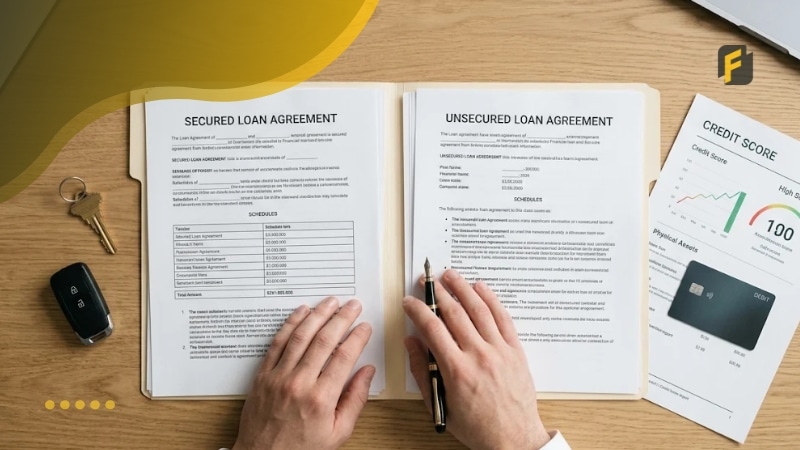
The main difference between these two types of credit lies in the requirement of real collateral.
Advertisements
In secured loans, you pledge a valuable asset to the agreement, such as your house, car, or an investment account.
If you stop making payments, the lender has the legal right to seize and sell that asset to recover the money. Since the bank’s risk is significantly lower, it offers much lower interest rates and longer terms to pay back.
In unsecured loans, you do not offer any assets as security. The bank evaluates only your credit score, monthly income, and payment history.
Because the institution assumes greater risk in case of default. It charges higher interest rates and requires a stronger credit score for approval.
What are the most popular secured loans in the United States?

The US financial system offers several asset-backed credit options. Each product caters to a specific need and carries its own rules, costs, and asset risks.
1. Home Equity Loan and HELOC (Secured loans vs Unsecured loans)
A Home Equity Loan and a HELOC (Home Equity Line of Credit) use the equity built up in your primary residence as collateral.
The former provides funds upfront as a lump sum with a fixed rate. While a HELOC functions like a revolving line of credit with variable interest tied to the Prime Rate.
The primary advantage of these options is lower interest rates. Ranging between 7.49% and 8.66% per year in late 2026, alongside long repayment terms of up to 30 years.
On the other hand, borrowers face closing costs ranging from 2% to 5% of the approved amount. Including property appraisal and recording fees.
Another key point involves federal income tax in the US under current law. You can only deduct interest on these loans if the funds are used to buy, build, or substantially improve your home.
This type of credit is suitable only for homeowners requiring substantial amounts for large projects.
2. Auto Loans and Auto Title Loans
Traditional vehicle financing (auto loan) uses the purchased car as collateral for the payments.
For borrowers with super prime credit scores (above 781 points). Average interest rates hover around 4.41% for new cars and 6.29% for used cars. Making this the most affordable way to finance a vehicle.
The issue arises when consumers resort to auto title loans. A predatory lending option that uses the title of a fully paid-off car as short-term collateral.
These loans carry average APRs near 300% (around 25% per month) and require repayment within 30 days.
Data from the Consumer Financial Protection Bureau (CFPB) shows that one in five borrowers loses their vehicle to repossession under this model.
While a traditional auto loan serves buyers seeking structured monthly payments, title loans should be avoided at all costs.
3. Securities-Backed Line of Credit and Credit-Builder Loans (Secured loans vs Unsecured loans)
Investors with taxable stock or bond portfolios exceeding USD 100,000 can secure a Securities-Backed Line of Credit (SBLOC).
As a rule, this facility offers competitive rates between 5.81% and 7.02% without requiring you to liquidate assets and trigger capital gains tax. Though the bank may liquidate assets if the market drops significantly.
On the opposite end of the spectrum are credit-builder loans. Designed for individuals lacking an established credit history in the US.
In this reverse-collateral structure, the bank holds the funds (generally USD 600 for 12 months) in a locked account and releases the money only after all payments are completed.
Studies by the CFPB indicate that this tool increases the probability of establishing a credit score by 24% for individuals without existing debt, leading to average gains of up to 60 points. However, it is not recommended for those already struggling with debt, as late payments can further lower scores.
Why can a loan with a lower interest rate end up costing more in total?
Many consumers assume secured loans are always cheaper because of lower advertised nominal rates.
In reality, fixed costs such as appraisals and title fees can flip the math for smaller amounts or shorter terms.
Consider needing USD 10,000 net over a 24-month term.
An unsecured personal loan at 11.90% APR results in monthly payments of USD 470.27, bringing total interest paid to USD 1,286 over two years.
If you choose a Home Equity Loan at 7.76% APR for the same net amount. You will pay around USD 1,100 in fixed closing costs.
Financing those closing costs increases the monthly payment to USD 500.81 and total borrowing costs to USD 2,019 equivalent to an effective annual rate of 18.32%.
For 24-month terms, using home equity only becomes financially advantageous for loan amounts exceeding USD 25,000.
Because institutions enforce unique fee structures and minimum credit scores, reviewing an updated loans comparison best rates guide before submitting applications helps identify lenders offering the lowest overall cost for your profile.
Which credit option makes the most sense for your finances today? Step-by-Step Guide
To choose the safest, most cost-effective credit line for your financial situation, follow these practical steps before signing any contract:
- Evaluate loan amount and timeframe: Choose unsecured personal loans for amounts under USD 20,000 or short terms under two years to avoid high upfront closing costs.
- Check your credit score for free: Scores above 740 points unlock the lowest unsecured rates at banks and credit unions. Eliminating the need to risk personal assets.
- Calculate total cost using APR: Look beyond the monthly interest rate. Compare the APR (Annual Percentage Rate), which incorporates origination fees and mandatory charges.
- Use soft-pull pre-qualification: Request pre-approvals that do not impact your credit score to compare real offers across multiple lenders.
- Submit formal applications within 14 days: When ready to apply (causing hard inquiries). Submit all applications within a two-week window so FICO and VantageScore 4.0 models treat them as a single inquiry.
- Protect essential assets: Avoid putting your home or primary work vehicle on the line to fund consumer expenses like credit card debt or vacations.
Conclusion
Mastering the differences between secured loans vs unsecured loans allows you to save thousands of dollars in interest without exposing your personal assets to unnecessary risk.
While secured loans offer lower rates for major real estate projects or vehicle purchases, unsecured options deliver speed, predictability, and full protection for your personal property.
Before signing with the first bank you find, check your current credit score and determine how much you can afford each month without straining your budget.
Compare at least three pre-approved offers today to secure the lowest total cost and keep your financial health in the United States fully on track.