



Advertisements
Looking for the best business loans startup entrepreneurs USA to boost your project? The financial market offers various credit lines, each designed with the purpose of meeting a different stage of the entrepreneurial journey.
Now, which of the business loans startup entrepreneurs USA is ideal considering your company’s current stage? Note that while some business loans startup entrepreneurs USA focus on immediate working capital, others require real collateral aiming for structural expansions.
Advertisements
In this article, we will explore the main alternatives for business loans startup entrepreneurs USA seeking secure decisions. We will compare the characteristics of these business loans startup entrepreneurs USA, from SBA rates to the agility of fintechs, ensuring the lowest capital cost.
Best Business Loans Startup Entrepreneurs USA Options
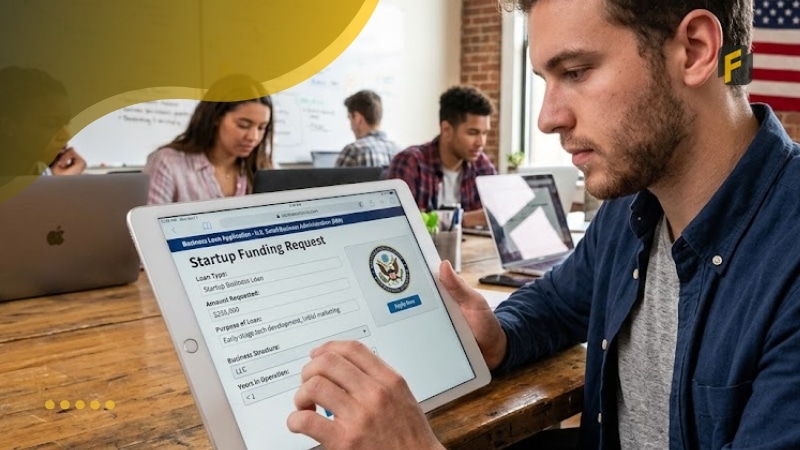
The following selection details the institutions that dominate the business loans startup entrepreneurs USA market. Each analysis focuses on objective data about rates, benefits, and numerical qualification criteria.
1. SBA 7(a) Program
Advertisements
The 7(a) program from the Small Business Administration (SBA) is the gold standard for long-term financing.
Interest rates range from 9.75% to 13.25% with the goal of covering terms up to 10 years for working capital or 25 years for real estate.
In this option, the main benefit is the government guarantee of up to 90% for loans under $350,000, which reduces the risk for the partner bank.
As a rule, the indicated profile requires a personal credit score above 680 and a demonstration of positive net income in the last 2 years of operation.
2. SBA Microloans
To meet immediate smaller needs, the SBA Microloan offers up to $50,000 with fixed rates between 8% and 13%.
You should know that the central benefit lies in the mandatory technical support, where the entrepreneur receives free financial mentorship.
Furthermore, the ideal audience is early-stage companies that have not yet achieved large volumes of revenue, but that have a solid business plan and a 640 credit score. About 26% of these funds are allocated to startups with less than 24 months of activity.
3. SBA 504 Loan
The 504 program is focused on fixed assets and heavy infrastructure. Rates are fixed and range from 6.5% to 8.5%, with terms of 10, 20, or 25 years.
Moreover, the great benefit is the requirement of only a 10% down payment, preserving the startup’s cash to cover other operating expenses.
Also note that the indicated profile is for industrial or technological expansion companies that need to acquire assets up to $5,500,000 and have a tangible net worth less than $15,000,000.
4. Bluevine (Business loans startup entrepreneurs USA)
Bluevine leads the fintech category with revolving credit lines up to $250,000. Monthly rates start at 1.5%, which is equivalent to approximately 18% annually for high-quality profiles.
It is worth noting that the biggest benefit is speed, with approval in 5 minutes and access to money in 24 hours.
Furthermore, the indicated profile requires 12 months of operation, at least $10,000 in monthly revenue, and a minimum FICO score of 625, making it ideal for covering seasonal inventory gaps.
5. Fundbox
Seeking to serve extremely young companies, Fundbox offers credit lines up to $150,000 with rates varying from 15% to 79% APR.
Firstly, the benefit is the ease of technological integration, analyzing bank data instead of piles of paper.
In addition, the target audience is entrepreneurs with only 3 months of activity and a minimum annual revenue of $30,000.
Also know that there are no penalties for early payment, allowing the startup to strategically reduce interest costs.
6. Accion Opportunity Fund (Business loans startup entrepreneurs USA)
Accion operates as a community lender with a social focus, offering between $5,000 and $250,000. Rates are competitive, ranging between 7% and 22% per year.
Firstly, the main benefit is the flexibility in approval criteria, looking to understand the character and potential of the project beyond the cold numbers.
As a rule, the indicated profile focuses on entrepreneurs from underrepresented communities who have at least 12 months of revenue and seek to strengthen the local economic impact.
7. Lendio
As a marketplace, Lendio connects the startup to more than 75 simultaneous lenders to obtain loans that reach $2,000,000.
You should know that rates vary drastically according to the chosen product, from 3% for equipment financing up to 30% for capital advances.
Moreover, the benefit is time savings, making a single application for multiple offers.
Initially, the indicated audience encompasses everything from seed startups to mature companies, requiring a minimum score of 560 to access basic options.
8. AltLINE (Business loans startup entrepreneurs USA)
AltLINE specializes in invoice factoring with limits up to $5,000,000 monthly. Service fees range between 1% and 5% of the advanced invoice value.
It is worth noting that the central benefit is the absence of debt on the balance sheet, as it is an anticipation of receivables.
Furthermore, the indicated profile is for B2B startups with 6 months of revenue that have corporate clients with an excellent payment history, not depending on the founder’s credit score.
9. National Funding
Aiming for technological modernization, National Funding finances equipment up to $150,000. Rates depend on the type of machinery, but installments are designed to fit the monthly cash flow.
As a rule, the benefit is that the equipment itself serves as the sole collateral for the loan.
Moreover, the indicated profile is for manufacturing or service startups that have been operating for at least 6 months and generate $250,000 in gross annual revenue.
10. OnDeck (Business loans startup entrepreneurs USA)
OnDeck offers installment loans up to $250,000 with average APR rates of 35% to 60%.
In addition, the main benefit is positive reporting to business credit agencies, helping the startup build its own financial reputation.
Furthermore, the indicated profile requires 1 year of foundation, $100,000 in annual revenue, and a personal score of 625 points, being a quick solution to enable immediate return investments.
Frequently Asked Questions about business loans startup entrepreneurs USA

In this section, we address the most common doubts of entrepreneurs seeking capital in the US to clarify the most critical points of the financing journey.
1. What is the minimum revenue required to obtain business credit in 2026?
The minimum revenue metrics required for startups in 2026 vary according to the selected creditor’s profile.
The current market has established $50,000 in gross annual revenue as the floor for most fintechs that operate automatically.
When seeking traditional banks and larger government programs, creditors prefer to see stable cash flows that allow for a debt service coverage of at least 1.25x.
This generally implies annual revenues exceeding $250,000 to ensure the company can support the debt without suffocating daily operations.
2. Is it recommended to use personal loans to finance the initial business?
Many entrepreneurs use personal loans to finance their businesses; while common, this practice carries significant financial risk.
Personal loans are based entirely on the founder’s individual score and do not offer protections against business failures.
Although they offer initial flexibility for those without revenue, they do not help build the company’s credit and put the individual’s physical assets at direct risk.
The ideal is to migrate towards business credit as soon as the first revenue is proven and legally declared.
3. How does inflation impact the variable interest rates of commercial loans?
Inflation directly impacts variable-rate loans, which are tied to the Federal Reserve’s Prime rate.
Therefore, if inflation persists above the target, the monthly cost of debt service instantly increases for those with flexible contracts.
In uncertain economic climates, financial experts recommend locking in fixed rates for long-term loans to guarantee absolute cost predictability.
Moreover, acceptable collateral generally includes liquid assets or real estate. Inventory usually suffers a significant discount in the technical valuation.]
Conclusion
Access to business loans startup entrepreneurs USA in 2026 requires a combination of a solid credit score above 650 and proven annual revenues of at least $50,000.
Government programs like the SBA 7(a) offer the lowest rates, varying from 9.75% to 13.25%, while fintechs like Bluevine prioritize speed with approvals in minutes for urgent working capital.
Here’s the tip! The choice of credit must be guided by the return on investment and the capacity to pay, avoiding compromising the personal assets of the partners. Having clarity about the numerical indicators and collateral requirements differentiates startups that scale safely from those that face early liquidity crises.
If none of the options caught your attention, we recommend you check out the best small business loans rates now.